Sunday, May 12, 2013

About that other bird...

owl

Owly was last seen the morning of April 3, taking shelter on an unseasonably cold, windy, wet morning. Owly hung out most of the day, then left. I knew it was the same owl because of the missing tufts above the right ear. I've read owls use these houses for nesting only - no love connection, no need to hang around! I'm thrilled Owly paid us several visits, and maybe next year there will be owlets. I'll be sure to make sure the house is clean and ready for Owly's return next spring.


Words and photos © 2009-2013 Caroline Homer for "The Shovel-Ready Garden". Unauthorized reproduction is prohibited.

Saturday, May 11, 2013

How to raise a mockingbird

In a nondescript boxwood hedge under our kitchen window,
boxwood

deep within its leaves,
boxwood

lies a little nest of twigs lined with all manner of natural and manmade textiles.
mockingbird eggs

We thought the nest had been abandoned, but last Saturday, all four eggs hatched,
newly hatched mockingbirds

and the proud parents made themselves quite visibly and audibly known. They stand watch day and night,
proud parents

and make multiple visits to the nest every hour to feed the babies.
feed the baby

Today the babies are a week old.
one week old

Mother and father are even more protective now,
look out

and swoop over my head when I get too close.
daddy mockingbird

The big baby in the middle is much larger than his nestmates.
baby mockingbirds

He's really good at begging to be fed!
feed me


Words and photos © 2009-2013 Caroline Homer for "The Shovel-Ready Garden". Unauthorized reproduction is prohibited.

Monday, April 15, 2013

Garden Bloggers' Tax Day - I mean Bloom Day


Sunday started out like this, on my back patio,
taxes
Taxes, boo

and ended like this, on the East Austin Urban Farm Tour.
springdale farm
Springdale Farm

boggy creek farm
Boggy Creek Farm

In between, I caught these pretties blooming in my garden.  It's warming up (high of 87 on Sunday!) after a cool, damp spring, and the tropicals are starting to take off.

esperanza
Esperanza

plumbago
Plumbago

sapphire showers duranta
Duranta

The early-blooming roses are past their peak while the late bloomers have yet to get going.
'Old Blush' rose
'Old Blush'

buff beauty
'Buff Beauty'

'Mutabilis'
'Mutabilis'

Native wildflowers are in full swing -

columbine
Columbine

pink evening primrose
Pink evening primrose


zexmenia
Zexmenia (non-native gopher plant in the foreground)


- as well as some not-so-wildflowers.  Somehow, the birds and squirrels have managed to cultivate sunflowers in the shade.  Come to think of it - that's pretty wild!

shady sunflowers
Shady sunflowers

Happy Garden Bloggers' Bloom Day from Austin, Texas!  Visit May Dreams Gardens to see what's springing up in gardens all over the world.

Words and photos © 2009-2013 Caroline Homer for "The Shovel-Ready Garden". Unauthorized reproduction is prohibited.

Friday, March 22, 2013

I love bees

I got stung by a bee on Sunday.  I can't remember the last time I got stung by a bee. My childhood bee memories are hazy.  I remember my sister getting stung by a wasp - my parents called it a 'yellow jacket'. And I remember my sister getting bitten by fire ants. My dad tried blasting the ants off her legs with a garden hose; when that didn't work, he brushed the ants off with his hands.

I remember bumblebees buzzing lazily around a flowering Texas mountain laurel bush on the corner where the neighborhood kids congregated to wait for the snow cone truck every Saturday afternoon.  I probably was stung, as a child, although the event isn't suspended in the amber of my mind, encapsulated, crystallized, like it is in Jack's.

Sunday's bee sting episode was really random. Our garden attracts lots of bees - yay! - and we've had the doors wide open while working on remodeling our kitchen, because the weather's been so nice.  Bees outside, open doors - what could possibly go wrong? Well, early Sunday afternoon,  I found a bee crawling on the kitchen floor, and I stepped on it.  It was instinctive.  Spot a bug near shoe - stomp. I regretted it as soon as I did it.  I wiped the bee off the sole of my shoe with a paper towel, and put it in the trash. I didn't tell Jack about the bee.  He doesn't like bees.

At some point in the day, a second bee flew in the house and into our kitchen sink, and crawled under a wet dishtowel.  When I went to rinse out the dishtowel at the end of our 10-hour marathon DIY session, the bee gave her life, in valor, as she sank her sword into my palm.  My hand hurt super bad, all of a sudden, and I didn't know what had happened. When I spotted the microscopically-tiny venom sack in my hand, I instinctively scraped it off, while wondering "Wow!  - and OW! - Is that the world's smallest venomous spider or what?"

Then I saw the bee, crawling slowly in the sink, its life force fading away, and I knew what had happened.  Jack didn't even have to see the bee; he knew I'd been stung, just from my reaction.  He seemed amused by this course of events, teasing me by saying, "I thought you were the 'bee whisperer.'"  I wiped the bee's lifeless body out of the sink with a paper towel and put it in the trash. My hand hurt a lot for a few minutes - ok, a few hours - got slightly red and swollen, then returned to normal in a day or so.  I felt worse for the bee, though.

This evening, Jack spotted a third bee, buzzing against the window over the kitchen sink, behind the open mini-blinds,  like a housefly.  The thought of the bee sting on Sunday crossed my mind, briefly.   Then I grabbed a small cup - a bright orange-colored plastic juice cup - and some take-out menus.  I went back to the windowsill and watched the bee for a few seconds, placing the menus on the countertop next to the sink.  The bee seemed really scared, fluttering above the lower sash, buzzing loudly.  I raised the mini-blinds, slowly.  Jack watched, reminding me that I got stung on Sunday - remember?  - in a concerned tone of voice.

I trapped the bee by pressing the cup against the window, over her.  I still had the mini-blind drawcord in my left hand, because I couldn't raise the cord over my head far enough to the right to lock the blinds in place.  Oh, but she was mad, so mad, buzzing mad.  I held the cup against the glass, patiently, until she stopped buzzing.  Jack asked if I wanted a step stool to stand on, watching me as I leaned over the counter, cup in right hand placed high against the window, drawcord in the left hand.  I nodded as I said,  "Yes, and could you grab this cord and lock the blinds?"

Blinds locked in place and bee quiet, I grabbed a couple of menus and slid them under the cup, while pressing the cup firmly against the windowpane. The bee started buzzing again, although not as aggressively.  I could see two of the bee's feet wriggling outside the cup's rim.  I let up the pressure on the cup, ever so slightly, until the bee's feet disappeared, then pressed down again.  I hoped I hadn't squished any of the bee's toes. (Do bees have toes?)

Slowly, gingerly, I slid my hand between the menus and the window, pressing the folded paper ever more firmly against the cup. The paper seemed awfully thin and flimsy.  I stepped off the step stool, held the cup up to my face and peered at the cup's rim. I saw a small gap between cup and paper, and took a breath.  I knew if the bee got out of the cup, she would sting me.  I pressed the menus down harder against the cup with the palm of my left hand - the same hand that was stung on Sunday - and asked Jack if he could please open the back door for me.

Arms outstretched, I stepped outside and headed for the bolted fall garden as briskly as I could.  I dropped the cup on the ground under the flowering arugula and stepped back.  The menus fell aside and the bee flew out of the cup, quickly, hovering above the cup until --

I don't know what happened next with the bee.  I didn't hang around to see.  I ran back in the house and slammed the door - slammed all the doors.  Then I went up to the window and looked out on the front garden.  The garden was buzzing with bees, sweet little bees, bumbles and honeys, drinking nectar from all the flowers.

No photos, as I'm sure you'll understand.

~~~

I think this excerpt from the Utah Education Network's bee page would make a great illustrated children's book.  As I read it, I imagined every sentence on a separate page with an illustration by Maurice Sendak or Antoine de Saint-Exupéry.

Each hive can have only one queen bee. When a hive gets too large with too many bees in it, the queen bee instinctively lays some special eggs in long cells. These will hatch into new queen bees. The queen then sends out scouts to find a new place for a hive. When a suitable site is found, she leaves the old hive. When she leaves, she is followed by many of the worker bees. This big mass of flying bees is called a swarm. Meanwhile, the new queen bees are hatching out in the old hive. Since each hive can only have one queen, the strongest new queen bee kills the other queens. She then flies out of the hive and is followed by all of the drones whose job it is to mate with her. This is the only time that she will mate, and this one important flight lays the foundation for all the eggs that she will ever lay in her lifetime.


Words and photos © 2009-2013 Caroline Homer for "The Shovel-Ready Garden". Unauthorized reproduction is prohibited.

Saturday, March 16, 2013

Neglected


As the dandelions can attest,
dandelion seeds

my garden's been terribly neglected lately.
dandelion

(And my blog has been, as well.)

My fall garden has bolted, and I haven't had a chance to clean it up.
arugula

Not that the bees mind.
bee and broccoli

I read somewhere that flowering winter vegetables are a critical food source for bees at winter's end, before spring's flowers arrive.
broccoli and bee

However, the spring flowers are out now, so it wouldn't hurt the bees to pull these out.

But I'm in the midst of a DIY kitchen remodel, and at the end of each day, I feel rather like this flopped-over iris -
cemetery iris

- and so the garden will have to wait.

They call these "cemetery irises" because they're often found in cemeteries, thriving on neglect.  Well, that's what they're getting in my garden - a whole lot of neglect.
cemetery irises

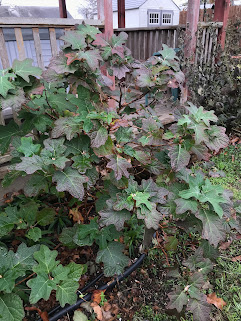
In the garden in front of the house, I managed to get the boxwood house "mustache" trimmed, but I didn't get this lanky lantana cut back before it burst into bloom.
lantana

 (Aaugh, is that a sprig of Bermuda I see?)

I got the salvias cut back, including this 'Cherry Sage',
cherry sage

but not the globe mallow, because it insisted on blooming all winter, like a freak.
globe mallow

I didn't get the leaves raked up before the blackfoot daisies sprung up,
globe mallow & blackfoot daisies

and I didn't get the gopher plant cut back, either.
gopher plant

Well, it's too late now.  Daytime temps have hit the 80's this week, and this Caesalpinia mexicana thinks it's in the tropics.
Mexican Bird of Paradise (Caesalpinia mexicana)

Looks like it's going to be a short, dry spring and a long, hot summer.

Happy (belated) Garden Bloggers' Bloom Day!  Visit May Dreams Gardens to see what's blooming in gardens all over the world.


Words and photos © 2009-2013 Caroline Homer for "The Shovel-Ready Garden". Unauthorized reproduction is prohibited.

Sunday, February 24, 2013

Our very first Owl Shack tenant has arrived!


Last Tuesday, alone in the garden, I lamented the lack of wildlife in the habitat boxes we installed a few years ago.    Alas, I thought to myself, no bats in the bat house…
Empty bat house

…and, Big Noisy Sigh, no owls in the owl shack. 
Eastern screech owl

Um… wait, what?

Well, hello!  We have an owl!  First owl we've seen in the Owl Shack since we put it up in 2010.  I'm guessing it's a she, but just in case, I've given it an unisex name - Owly. 
Eastern screech owl

Owly seemed as surprised to see me as I was to see Owly.  Neither one of us was quite ready for photos at this time of day, but we did our best to document the occasion.
Eastern screech owl

Jack installed the Owl Shack up on one of the posts of our backyard gazebo, as we didn't have any trees that met the criteria listed for optimum placement.  The eaves are about 10 feet up off the ground, but standing on the deck, I can touch the bottom of the owl box - it's that close.  Owls are remarkably tolerant of humans, particularly in urban areas, and have been known to lay eggs in things like windowboxes, well within reach of people.

Owly made lengthy appearances on Tuesday and Wednesday, then seemingly disappeared.  However, I heard rustling sounds from within the box, so I'm hopeful there's owl brooding going on in there (and not birds or squirrels nesting).  I hesitate to peek in the box to see what's up.  Plus, those talons! 

So for now,  I'll have to console myself with the videos on Chris' Eastern Screech Owl Nest Box Cam website.  Chris Johnson, who lives in Austin, has an incredibly high-tech owl house complete with owl cam and temperature gauge. Unlike me, Chris has no qualms about climbing up and reaching into his owl box, not just for a peek, but to remove, count, weigh and measure eggs and even owlets (while momma owl is out of the box, that is).  His owl webcam site and its accompanying blog, Partial Perspective Vortex, provide a wealth of information about the mating and breeding habits of the Eastern Screech Owl in Central Texas.  

It's likely Mr. and Mrs. Owly have been checking out and visiting my Owl Shack since December, and may have even temporarily stored food there (like leftovers in the fridge, says Chris) - the owls oblivious to me and vice versa.  And his momma owl has already laid her clutch of eggs, a month earlier than typical years. Perhaps my Owly has, too; or perhaps she and Mr. Owly are still in pre-nesting mode, making intermittent visits like a prospective home-buying couple.

If you want your own Owl Shack, you can get one like mine from Texas ornithologist Cliff Shackelford, author of Hummingbirds of Texas.  Cliff builds Owl Shacks to order from recycled and new cedar fence wood.   The Owl Shack website has tips on how to place the houses to best attract owls. Or, look for owl house plans online and build your own.

I also stumbled across this Cornell webpage on owl anatomy and behavior while looking for information on owl ear tufts, as Owly seems to be missing some feathers above her right ear.  I learned that owl ears are asymmetrical, and that owls use their ear tufts to communicate. 

Updates to follow as they become available!

Words and photos © 2009-2013 Caroline Homer for "The Shovel-Ready Garden". Unauthorized reproduction is prohibited.

Sunday, December 16, 2012

It's official -


I’m a Master Gardener!

I'm a Master Gardener!


Words and photos © 2009-2012 Caroline Homer for "The Shovel-Ready Garden". Unauthorized reproduction is prohibited.